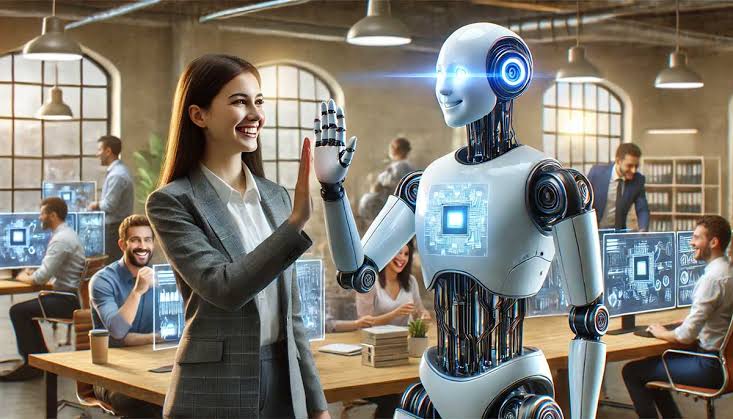
Artificial intelligence has become remarkably good at processing text, generating images, and answering questions.
Introduction
But a new challenge is emerging: how can AI systems understand the physical world well enough to make decisions in environments that change constantly?
This question is driving interest in world models and physical AI. Instead of focusing only on digital information, these technologies aim to help machines learn how environments behave, predict what might happen next, and interact with real-world objects.
The World Economic Forum included world models among its Top 10 Emerging Technologies of 2026, highlighting their potential for applications such as robotics and simulation. Gartner also identified physical AI as a major strategic technology trend for 2026.
Although these technologies are advancing, many applications remain experimental or limited to controlled environments. Their broader impact will depend on reliability, cost, safety, and real-world performance.
What Are World Models in Artificial Intelligence?
A world model is an AI system designed to learn how an environment behaves and use that understanding to predict possible future states.
For example, imagine a robot moving through a warehouse. It needs to understand where shelves are located, how objects move, which paths are blocked, and what may happen if it picks up a particular item.
A world model can help represent these relationships and predict the likely consequences of different actions.
Unlike a conventional chatbot that primarily responds to language prompts, a world-model-based system aims to build a representation of how its environment changes over time.
Such systems may learn from combinations of video, images, sensor readings, simulations, and other data.
How Does a World Model Work?
1. Observe the environment
Collect images, video, and sensor information.
2. Learn patterns and relationships
Build an internal representation of objects, movement, and surroundings.
3. Predict possible outcomes
Estimate how the environment might change after an action.
4. Plan and evaluate actions
Choose an action and assess the result using feedback.
This is a simplified explanation. Real systems can use different architectures and may combine world models with planning algorithms, language models, control systems, and robotics software.
What Is Physical AI?
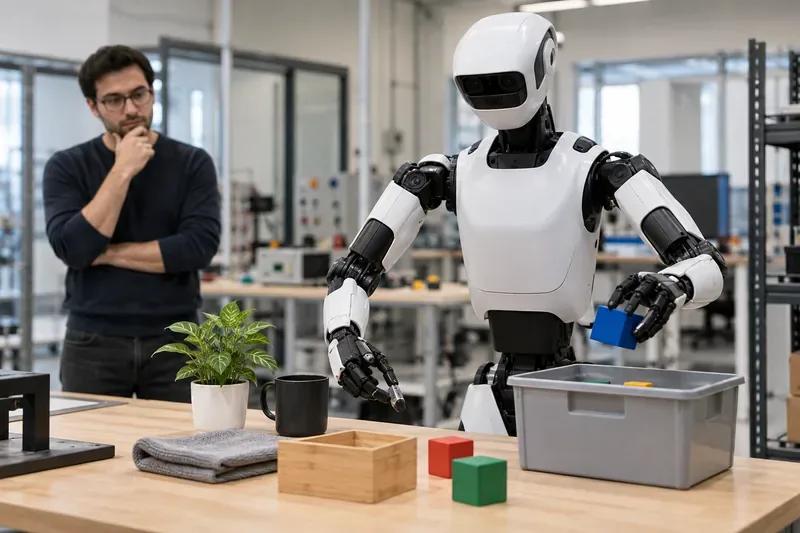
Physical AI refers to AI systems that perceive and act within the physical world through machines such as robots, autonomous vehicles, and intelligent industrial equipment.
These systems combine software intelligence with hardware capabilities. They must interpret their surroundings and respond to real-world constraints such as friction, weight, distance, obstacles, and unpredictable movement.
For example, a digital AI system might describe how to pick up a cup. A physical AI system controlling a robot must actually locate the cup, calculate an appropriate movement, grip it without crushing it, and respond if the cup slips.
This makes physical AI substantially more challenging than generating a digital response.
Five Industries That Could Benefit From World Models and Physical AI
1. Manufacturing and Industrial Automation
Factories use robotic systems for assembly, inspection, packaging, and material handling.
World models could help these systems simulate movements, anticipate collisions, and evaluate alternative workflows before operating on physical equipment.
Potential benefits include improved planning, fewer unnecessary movements, and more efficient production processes.
However, industrial robots still require carefully engineered safety mechanisms, reliable sensors, and validation before being deployed around workers.
2. Agriculture and Smart Farming
Agriculture presents a challenging environment because crops, soil conditions, weather, and field layouts vary.
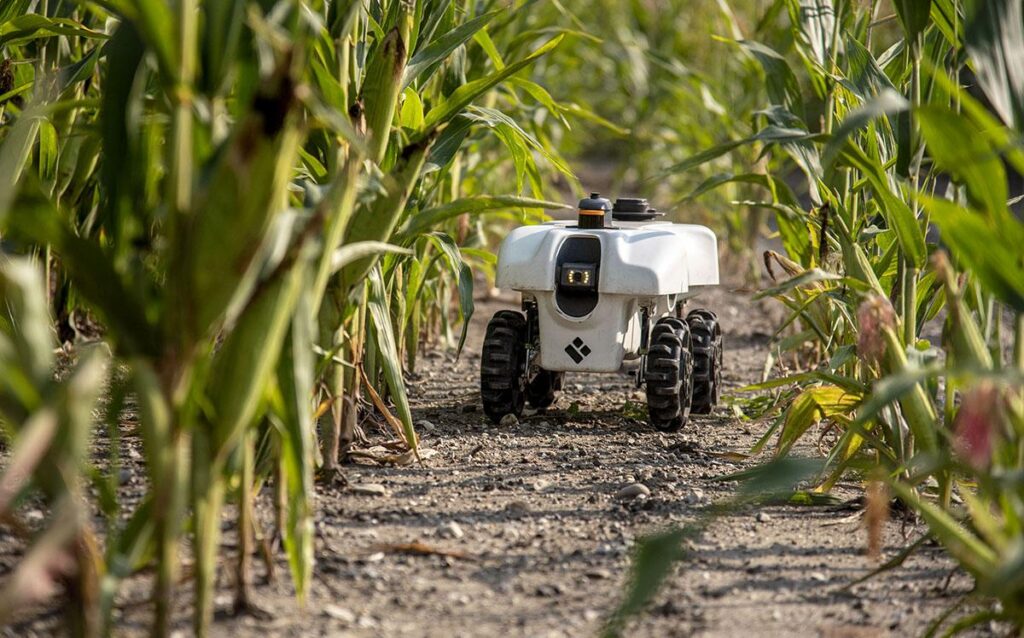
Physical AI could support agricultural robots that identify crops, detect weeds, navigate fields, and assist with harvesting.
World models could also help simulate how machines might move through different field conditions before performing a task.
These applications may be particularly useful where repetitive manual work is difficult, although affordability and performance in real outdoor conditions remain important barriers.
3. Warehousing and Logistics
Warehouses depend on the coordinated movement of products, people, and machines.
AI-powered robots can help transport packages, organise inventory, and support picking operations. Predictive models may help them plan routes, recognise obstacles, and adapt to changing warehouse layouts.
The main challenges include safe human-robot interaction, handling unusual objects, and maintaining reliable performance during busy operating periods.
4. Healthcare and Assisted Living
Robotics research is exploring how intelligent machines could assist with repetitive tasks, material transport, rehabilitation, and certain forms of physical assistance.
World models may help robotic systems predict movement and plan interactions in structured environments.
However, healthcare requires particularly high standards of safety, reliability, privacy, and clinical oversight. Research prototypes should not be confused with widely available, independently validated medical solutions.
5. Autonomous Vehicles and Smart Cities
Autonomous vehicles must interpret roads, traffic signals, pedestrians, cyclists, and unexpected events.
Models that predict how the environment may change could support planning and simulation. Developers can test different driving scenarios virtually before evaluating systems in real-world conditions.
Nevertheless, predicting the behaviour of other road users is difficult. Simulation alone cannot establish that an autonomous system is safe for unrestricted public-road use.
Why Is This Technology Becoming Important in 2026?
Three developments are helping move physical AI and world models forward.
More powerful AI computing: Modern accelerators and AI infrastructure make it possible to train and run increasingly sophisticated models, although costs and computing requirements remain substantial.
Improved simulation environments: Developers can test robotic behaviour in virtual settings before using expensive or potentially dangerous physical equipment.
Better combinations of sensors and AI: Cameras, depth sensors, motion sensors, and other devices can provide richer information about an environment.
The World Economic Forum’s 2026 emerging technologies report identifies world models as an important development because of their potential to help AI reason about physical environments and situations it has not directly encountered.
World Models vs Traditional AI vs Physical AI
| Feature | Traditional AI applications | World models | Physical AI |
|---|---|---|---|
| Main purpose | Process information or generate outputs | Learn and predict environmental changes | Perceive and act in the physical world |
| Typical inputs | Text, images, structured data | Images, video, sensor data, simulations | Sensor readings and environmental observations |
| Typical outputs | Answers, predictions, recommendations | Predicted states and possible outcomes | Physical movements or machine actions |
| Example | Chatbot answering a question | Predicting a robot’s possible movement outcomes | Robot moving an object |
| Key challenge | Accuracy and reliability | Accurate predictions in unfamiliar situations | Safe, reliable real-world operation |
These categories can overlap. A physical AI system may use a world model alongside other AI models and conventional control software.
What Are the Biggest Challenges?
Despite the excitement, several problems must be solved before these technologies can be used reliably at scale.
High computing costs: Training advanced models and simulating complex environments can require expensive hardware and infrastructure.
Limited real-world data: A model trained in one environment may struggle in another with different objects, lighting, weather, or layouts.
Prediction errors: A world model can make incorrect predictions, particularly in unusual or unfamiliar situations.
Safety concerns: Robots must be able to respond appropriately when a person enters their path, a sensor fails, or an object behaves unexpectedly.
Privacy and security: Systems that continuously collect video and sensor data need appropriate access controls and privacy protections.
Evaluation difficulties: A robot performing well in a simulation does not automatically prove that it will work safely and reliably in the real world.
Addressing these challenges will require improvements in model design, hardware, testing, engineering, and safety standards.
What Skills Will Matter for Careers in Physical AI?
This technology creates opportunities across several technical disciplines.
- Programming: Python, C++, and software engineering fundamentals.
- Artificial intelligence: Machine learning, deep learning, and computer vision.
- Robotics: Robot operating systems, motion planning, and feedback control.
- Simulation: Virtual environments, physics engines, and synthetic training data.
- Systems engineering: Sensors, embedded systems, hardware integration, and safety testing.
- Cloud and infrastructure: Data pipelines, model deployment, and scalable computing.
Frontend and full-stack developers can also contribute by building robotics dashboards, fleet-monitoring interfaces, simulation visualisations, and applications that help operators control and monitor intelligent machines.
Understanding software engineering fundamentals remains valuable even when working with advanced AI systems.
Conclusion
World models and physical AI represent an important direction in technology because they aim to connect artificial intelligence with the physical world.
From smart factories and agricultural robots to warehouse automation and autonomous systems, these technologies could enable machines to plan more intelligently and adapt to changing conditions.
However, their future will depend on more than impressive demonstrations. Reliability, safety, cost, and the ability to perform consistently in real environments will determine how widely they are adopted.
For developers and technology professionals, understanding these emerging fields can provide valuable insight into the next phase of AI innovation.